Threat or Challenge: Why Your Nervous System Decides Before You Do
A neuroscience-informed manifesto on vitality, threat, and adaptive intelligence
Why the Resilient Brain
Modern life places unprecedented demands on the human nervous system.
We are expected to adapt quickly, think flexibly, regulate our emotions, and make sound decisions—often under chronic pressure.
Yet many of the systems that make adaptation possible are quietly depleted by the very conditions that require them.
The Resilient Brain is a framework for understanding this mismatch—and for restoring the vitality, orientation, and agency required to meet challenge without getting stuck in survival mode.
This manifesto lays out the core lens.
Most people think they “choose” how they respond to pressure. Neuroscience tells a different story.
Before conscious thought kicks in, your nervous system has already answered one question:
“Am I safe enough to adapt—or do I need to survive?
That split-second decision determines whether a situation becomes a threat to endure or a challenge to engage.
This is the hidden engine behind the negative side of the vitality paradox:
modern life steadily erodes vitality while demanding ever-greater adaptability.
⸻
Why “Fight-or-Flight” Is an Incomplete Story
Fight-or-flight describes what happens under threat—but not why some people get stuck there while others pivot into effective action.
When the nervous system detects danger—social, emotional, or cognitive—it reallocates resources fast:
• Attention narrows
• Time collapses into urgency
• Reflection goes offline
• Speed replaces flexibility
This is efficient for survival.
It is costly for learning, creativity, leadership, and growth.
The nervous system doesn’t respond to reality.
It responds to perceived safety and available resources.
⸻
Why Threat Takes Over So Easily
Whether a person reacts reflexively or adapts skillfully depends on four conditions already in place before the threat appears:
1. Baseline Vitality
Chronic stress, poor sleep, under-movement, and cognitive overload lower the nervous system’s tolerance for uncertainty.
Low vitality → faster threat labeling → rigid reactions.
2. Resource Availability
If the brain senses insufficient physical, emotional, or social resources, it defaults to protection rather than exploration.
No margin = no flexibility.
3. Inhibition Capacity
The ability to pause—even briefly—and prevent old survival patterns from hijacking behavior is a learned neural skill, not a personality trait.
4. Agency
The capacity to influence your own state, attention, and response. Time constraints, information overload, and distractions erode this capacity.
Without inhibition, the fastest habit wins.
⸻
How Threat Shows Up in Real Time
A threat response doesn’t announce itself politely.
It shows up as:
• Urgency without clarity
• Narrow, binary thinking
• Muscle tension and shallow breathing
• Repetitive mental loops
• A pull toward control, withdrawal, or over-efforting
These aren’t failures.
They’re signals.
They mean the nervous system is trying to keep you safe with limited tools.
Most advice fails here—because it starts after choice has already disappeared.
⸻
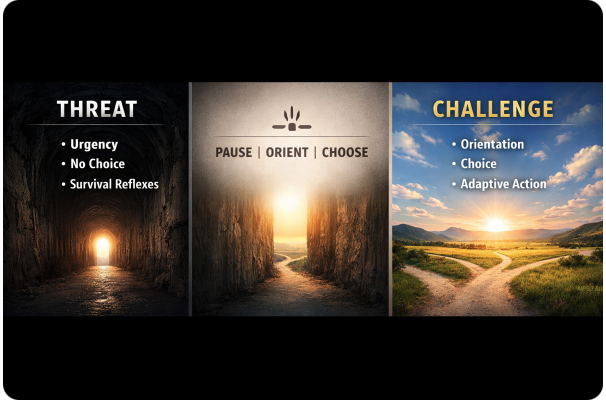
The Pivot: How Threat Becomes Challenge
The transition doesn’t happen through insight or positive thinking.
It happens in sequence.
1. Interrupt Speed
Slow the body first.
A longer exhale. A pause in movement. A softening of the eyes.
This prevents the survival cascade from fully locking in.
2. Restore Orientation
Threat collapses context. Everything feels urgent and personal.
Orientation restores time, space, and relevance.
Ask:
• What is actually happening right now?
• What is this situation really asking of me?
• What is mine to handle—and what is not?
Orientation tells the nervous system:
“I’m here. I’m not lost.”
3. Reintroduce Agency
Threat dominates when choice disappears.
Agency returns the moment one real option appears.
Not the full solution.
Not the perfect response.
Just one meaningful choice.
Choice signals safety.
Safety restores flexibility.
This is the exact moment threat becomes a challenge.
Threat responses are defined by loss of agency.
When the nervous system senses no options, it defaults to:
• Control
• Withdrawal
• Reactivity
• Over-efforting
Agency doesn’t require a big decision. It requires one real option.
Neuroscientifically, even small choices:
• Increase prefrontal engagement
• Restore dopaminergic motivation circuits
• Shift stress chemistry from defensive to mobilizing
Agency in real life looks like:
• “I can respond now—or after I walk.”
• “I can ask one clarifying question.”
• “I can choose the next step, not the whole solution.”
Choice is the gateway to challenge.
Now, the nervous system interprets options as safety.
⸻
Why Challenge Builds Vitality
When a situation is experienced as a challenge:
• Stress mobilizes without shutting down learning
• Perspective stays online
• Energy builds capacity instead of fueling coping
Challenge strengthens vitality because it recruits adaptive intelligence, not survival reflexes.
This is how pressure becomes developmental instead of depleting.
⸻
The Takeaway
Vitality isn’t a luxury.
It’s the precondition for adaptive intelligence.
If modern life keeps pushing you into threat mode, the solution isn’t tougher thinking.
It’s restoring the nervous system’s ability to say:
“This is hard—but I can meet it.”
That’s where resilience turns into growth.
⸻
I’m increasingly convinced that thriving in an unpredictable world isn’t about eliminating threat—it’s about building the capacity to transform it.
The practices, programs, and conversations I offer are all designed around this core question:
How do we restore vitality so challenge becomes possible again?
If you’re exploring that question too, you’re in the right place.